
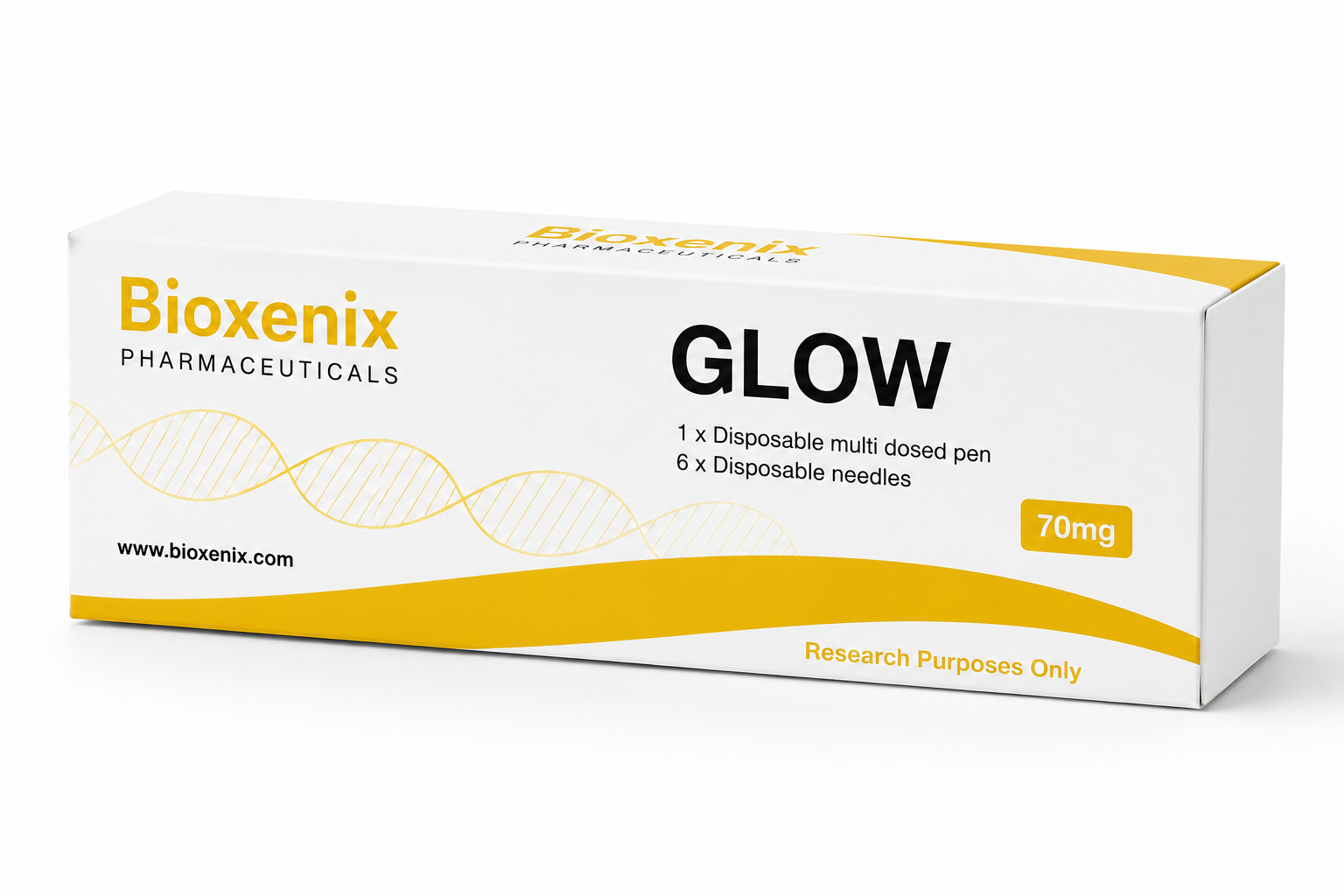
Bioxenix GLOW 70mg Prefilled Pen Kit
The Bioxenix GLOW 70mg Prefilled Pen Kit is a multi-peptide research formulation combining BPC-157, TB500, and GHK-Cu in a convenient prefilled pen format. The complete GLOW blend contains 70mg of peptide material, consisting of BPC-157 10mg, TB500 10mg, and GHK-Cu 50mg. Bioxenix lists the product within its Hair & Aesthetics, Pen Kits, and Peptides collections and identifies it as a research-use-only product.
The combination makes GLOW Peptide particularly relevant to laboratory research involving cellular signalling, tissue biology, extracellular matrix processes, skin research, regenerative pathways, and peptide interactions.
The prefilled pen format is designed to provide a ready-to-use research presentation without the reconstitution associated with a traditional lyophilised peptide vial. According to the current Bioxenix listing, each kit includes one prefilled pen and six disposable pen needles.
What Is Bioxenix GLOW 70mg?
Bioxenix GLOW 70mg is a combined peptide formulation bringing together three compounds with different areas of scientific interest:
- BPC-157 – 10mg
- TB500 – 10mg
- GHK-Cu – 50mg
- Total blend strength – 70mg
Bioxenix describes the blend as an advanced multi-peptide research formulation for investigations involving tissue regeneration, skin biology, cellular signalling, extracellular matrix function, and regenerative pathways.
Rather than studying a single peptide in isolation, researchers may find combination formulations useful when investigating several interconnected biological pathways.
The three components of the GLOW formulation have distinct research profiles, which makes the blend relevant to several areas of peptide science.
GLOW Peptide Composition
Understanding each component is important when evaluating the overall research profile of this formulation.
BPC-157 10mg
BPC-157 is a synthetic peptide that has been investigated extensively in preclinical research involving tissue biology, cellular signalling, angiogenesis, gastrointestinal research, and repair-related pathways.
Research involving BPC-157 has examined mechanisms associated with cellular responses and tissue processes. However, findings from experimental and preclinical research should not automatically be interpreted as evidence of established benefits in humans.
Within the GLOW formulation, BPC-157 represents one of the primary components associated with regenerative and tissue-biology research.
TB500 10mg
TB500 is commonly used as a research term for a peptide based on the active region of Thymosin Beta-4.
Thymosin Beta-4-related research has investigated cellular migration, tissue remodelling, angiogenesis, wound-healing pathways, and cytoskeletal processes.
Its inclusion in GLOW provides researchers with another peptide component relevant to regenerative biology and cellular movement.
GHK-Cu 50mg
GHK-Cu, also known as Copper Tripeptide-1, is a naturally occurring copper-binding peptide.
It has attracted considerable scientific interest in skin biology, extracellular matrix research, collagen-related processes, cellular communication, tissue remodelling, and cosmetic science.
GHK-Cu makes up the largest component of the GLOW blend at 50mg, giving the formulation a particularly strong connection to skin and extracellular-matrix research.
Why Study a Multi-Peptide Blend?
Multi-peptide research formulations allow scientists to examine several signalling pathways within one experimental model.
BPC-157, TB500, and GHK-Cu have different biological research profiles. Combining them creates an opportunity to investigate interactions between pathways associated with:
- Cellular signalling
- Tissue biology
- Extracellular matrix function
- Skin research
- Cellular migration
- Regenerative pathways
- Connective-tissue research
- Peptide-receptor interactions
- Laboratory models of tissue response
However, the presence of several peptides in a single formulation does not establish that the compounds produce a combined therapeutic effect.
Scientific conclusions should be based on appropriate experimental evidence rather than the ingredient list alone.
Bioxenix GLOW Prefilled Pen Format
One of the most notable characteristics of this product is the prefilled pen format.
Traditional research peptides are frequently supplied as lyophilised material in glass vials. A prefilled pen provides a different product presentation by supplying the formulation within a multi-dose pen.
According to the current Bioxenix listing, the GLOW pen kit includes:
- 1 prefilled multi-dose pen
- GLOW 70mg peptide blend
- 6 disposable pen needles
- Ready-to-use formulation
- No reconstitution required
- Research-use-only designation
For laboratories and researchers evaluating peptide formulations, the pen format may be of interest because it differs from conventional vial-based research products.
Bioxenix GLOW 70mg Product Specifications
| Product Feature | Details |
|---|---|
| Product | Bioxenix GLOW 70mg Prefilled Pen Kit |
| Total blend | 70mg |
| BPC-157 | 10mg |
| TB500 | 10mg |
| GHK-Cu | 50mg |
| Format | Prefilled multi-dose pen |
| Needles | 6 disposable pen needles |
| Reconstitution | Not required according to product listing |
| Research designation | Research Use Only |
| Brand | Bioxenix Pharmaceuticals |
These specifications reflect the current Bioxenix product listing.
GLOW Peptide and Skin Research
The term GLOW Peptide is particularly relevant to research surrounding skin biology because GHK-Cu is a major component of the formulation.
GHK-Cu has been studied in relation to extracellular matrix processes and skin biology. Researchers investigating peptide-based approaches to cellular and tissue research may therefore examine pathways involving:
- Collagen-related processes
- Extracellular matrix regulation
- Cellular communication
- Skin structure
- Tissue remodelling
- Fibroblast biology
- Oxidative-stress pathways
- Cellular regeneration
The addition of BPC-157 and TB500 broadens the research profile toward tissue-response and regenerative biology.
It is important, however, to distinguish laboratory research from proven cosmetic or medical outcomes.
GLOW Peptide and Regenerative Research
BPC-157 and TB500 are frequently investigated in experimental models relating to tissue response and regenerative biology.
BPC-157 research includes investigations into cellular and vascular pathways, while Thymosin Beta-4-related research has examined cellular migration and tissue remodelling.
GHK-Cu adds a separate area of interest involving extracellular matrix and skin-related research.
This combination makes the formulation suitable for researchers exploring multiple biological pathways within peptide science.
GLOW Peptide and Extracellular Matrix Research
The extracellular matrix is a complex network surrounding cells that provides structural support and participates in cellular communication.
GHK-Cu is particularly relevant to research involving extracellular matrix biology. Studies have examined its relationship with processes associated with collagen, tissue remodelling, and cellular signalling.
Researchers can therefore investigate the GHK-Cu component alongside BPC-157 and TB500 when studying broader tissue-response models.
BPC-157 vs TB500 vs GHK-Cu
Although all three peptides appear in the same formulation, they should not be considered interchangeable.
BPC-157 is primarily associated with experimental research into tissue biology, cellular signalling, vascular pathways, and regenerative mechanisms.
TB500 is associated with Thymosin Beta-4-related research, including cellular migration and tissue remodelling.
GHK-Cu is a copper-binding peptide with significant research interest in skin biology and extracellular matrix processes.
The combination creates a broader research profile than any one of these compounds alone.
Why GHK-Cu Is Important in the GLOW Blend
GHK-Cu accounts for 50mg of the 70mg total blend, making it the largest component.
Copper peptides have attracted substantial interest within cosmetic science and cellular biology. GHK-Cu is studied in relation to extracellular matrix regulation, cellular communication, tissue remodelling, and skin-associated pathways.
For researchers particularly interested in peptide-based skin research, this component is an important part of the formulation’s identity.
Research Quality and Product Evaluation
When evaluating a research peptide product, researchers should consider more than the stated milligram quantity.
Important factors include:
- Compound identity
- Peptide composition
- Labelled quantity
- Batch information
- Purity documentation
- Packaging integrity
- Manufacturer information
- Storage requirements
- Research-use designation
Bioxenix states that its peptide products are manufactured according to quality standards and that its GLOW formulation is third-party tested for identity and purity.
Researchers should always verify the documentation associated with the specific product or batch they receive.
Storage and Handling
Research peptide formulations should be stored according to the manufacturer’s current instructions and the requirements of the specific formulation.
Avoid unnecessary exposure to:
- Excessive heat
- Direct sunlight
- Contamination
- Unsuitable storage environments
- Repeated temperature fluctuations
Because peptide stability can depend on formulation and storage conditions, researchers should consult the product documentation supplied with their specific kit.
Appropriate laboratory handling procedures should also be followed.
Is GLOW Peptide the Same as GHK-Cu?
No.
GLOW Peptide is the name of a multi-peptide blend containing BPC-157, TB500, and GHK-Cu.
GHK-Cu is one individual component of the formulation and accounts for 50mg of the 70mg total blend.
Therefore, GLOW and standalone GHK-Cu should be treated as different research products.
GLOW 70mg vs KLOW 80mg
Bioxenix also lists KLOW 80mg, another multi-peptide formulation. KLOW contains BPC-157 10mg, TB500 10mg, GHK-Cu 50mg, and KPV 10mg, giving it a total blend strength of 80mg.
The primary distinction is therefore the additional KPV component in KLOW.
| Feature | GLOW 70mg | KLOW 80mg |
|---|---|---|
| BPC-157 | 10mg | 10mg |
| TB500 | 10mg | 10mg |
| GHK-Cu | 50mg | 50mg |
| KPV | — | 10mg |
| Total | 70mg | 80mg |
This comparison can be useful for researchers deciding which peptide composition better fits a particular research model.
Frequently Asked Questions
What is Bioxenix GLOW 70mg Prefilled Pen Kit?
It is a multi-peptide research formulation containing BPC-157, TB500, and GHK-Cu in a prefilled multi-dose pen format. Bioxenix lists the total blend strength as 70mg.
What is in GLOW Peptide?
The formulation contains BPC-157 10mg, TB500 10mg, and GHK-Cu 50mg. Together, these components provide a total labelled blend strength of 70mg.
How much GHK-Cu is in GLOW 70mg?
The Bioxenix formulation contains 50mg of GHK-Cu.
How much BPC-157 is included?
The formulation contains 10mg of BPC-157.
How much TB500 is included?
The formulation contains 10mg of TB500.
Is GLOW supplied as a prefilled pen?
Yes. Bioxenix currently lists GLOW 70mg in a prefilled multi-dose pen format. The kit includes one pen and six disposable pen needles.
Does the GLOW pen require reconstitution?
Bioxenix describes the prefilled pen as a ready-to-use formulation that does not require reconstitution.
What is GLOW Peptide used for in research?
The formulation is positioned for research involving tissue biology, cellular signalling, skin biology, extracellular matrix function, and regenerative pathways.
Is GLOW Peptide approved as a medicine?
The Bioxenix listing identifies the product as Research Use Only. It should not be represented as an approved medicine or established therapeutic treatment.
Important Research Information
Bioxenix GLOW 70mg should be considered a research formulation rather than a clinically established treatment.
The individual peptides within the blend have been investigated in scientific and preclinical settings, but research findings should not be interpreted as proof of safety or effectiveness for human treatment.
Anyone conducting legitimate laboratory research should follow applicable institutional procedures, scientific protocols, product documentation, and local regulations.
Summary
The Bioxenix GLOW 70mg Prefilled Pen Kit combines three research peptides into a single multi-peptide formulation: BPC-157 10mg, TB500 10mg, and GHK-Cu 50mg. The total blend strength is 70mg. Bioxenix supplies the formulation in a prefilled multi-dose pen with six disposable pen needles and identifies it as research use only.
Research Use Only. Not for human consumption or self-administration.
glow peptide,
glowing peptides,
peptides before after,
peptides before and after,
glow stack peptide,
glow pen,
glow stack,
before and after peptides,
ghk-cu peptide injection uk,
glow blend peptide,
glow pen peptide.
glow peptides,
grow peptide,
glow ghk-cu,
glow peptide dosage,
glow peptide uk,
klow peptide benefits,
glow ghk cu,
glow.peptide dosing,
kglow peptide,
alluvi glow pen,
glow blend,
glow injection.
Related products
Recovery & Wellness
GLP-1 / Weight Loss
Recovery & Wellness
GLP-1 / Weight Loss
GLP-1 / Weight Loss
GLP-1 / Weight Loss
GLP-1 / Weight Loss
GLP-1 / Weight Loss