
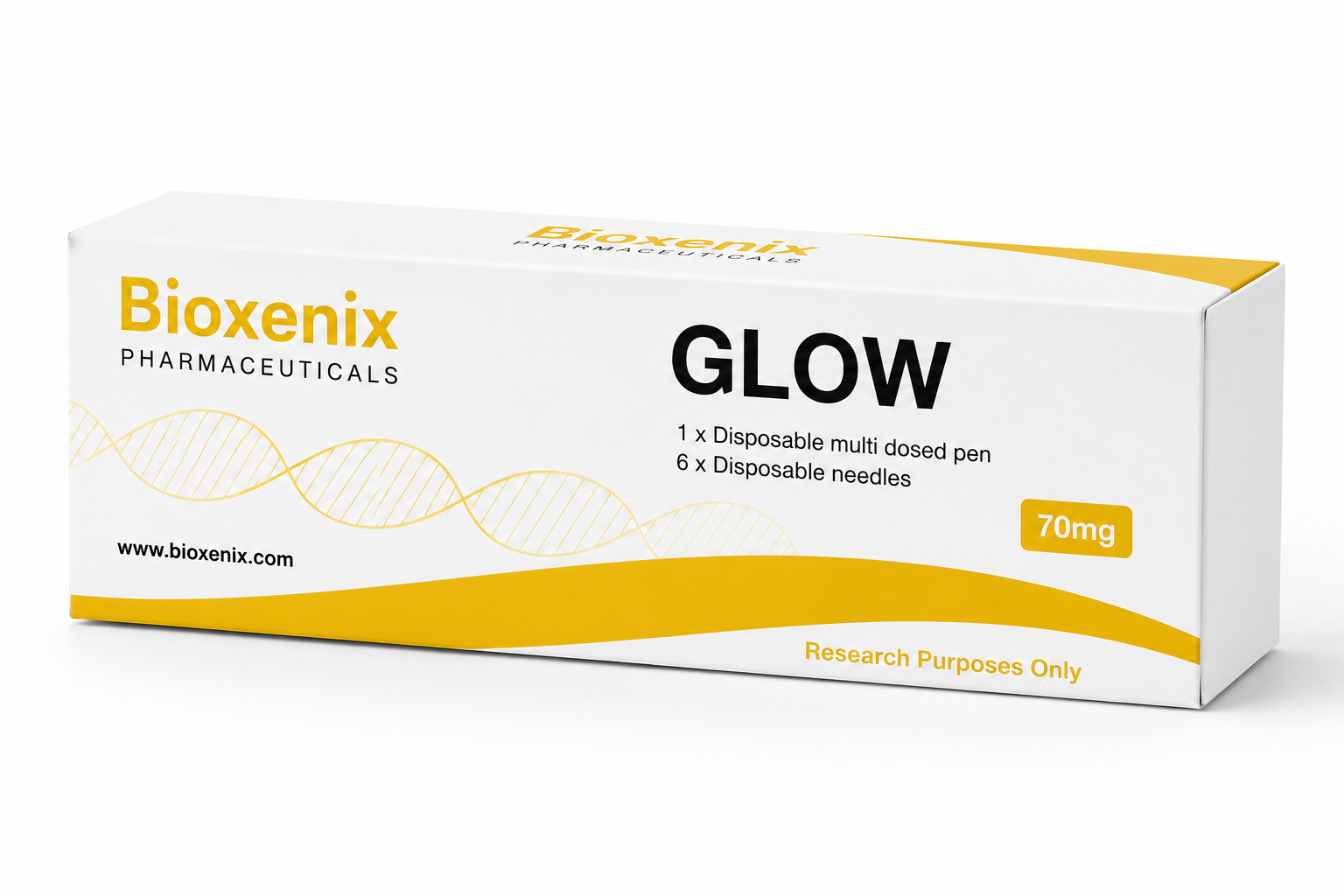
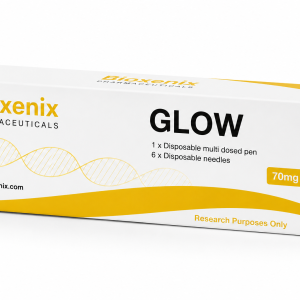
Bioxenix GLOW 70mg
Original price was: £95.00.£80.00Current price is: £80.00.
Bioxenix GLOW is a top-tier research peptide, renowned for its purity and consistency. Perfect for laboratory professionals seeking reliable results, Bioxenix GLOW delivers outstanding performance and quality assurance with every purchase.
Bioxenix GLOW Peptide
Bioxenix GLOW Peptide is a multi-peptide research blend combining BPC-157, TB500, and GHK-Cu in a single formulation. The current Bioxenix product listing identifies the blend as GLOW 70mg, containing 10mg BPC-157, 10mg TB500, and 50mg GHK-Cu. It is presented as a research-use-only peptide formulation.
This combination brings together three peptides that have been investigated across different areas of biological research, including cellular signalling, tissue biology, extracellular matrix processes, pigmentation and skin biology, and regenerative pathways.
What Is Bioxenix GLOW Peptide?
Bioxenix GLOW Peptide is a peptide blend designed around three well-known research compounds: BPC-157, TB500, and GHK-Cu.
Rather than containing a single peptide, the GLOW formulation combines multiple compounds with different research backgrounds. This makes it particularly relevant to researchers studying interactions between peptide signalling, cellular processes, connective-tissue biology, and skin-related pathways.
According to the manufacturer’s current listing, the 70mg formulation contains:
- BPC-157 – 10mg
- TB500 – 10mg
- GHK-Cu – 50mg
- Total blend strength – 70mg
- Lyophilised peptide formulation
- Research-use-only designation
Bioxenix GLOW Peptide Ingredients
Understanding the individual components provides useful context when researching this peptide blend.
BPC-157
BPC-157 is a synthetic peptide that has been investigated in preclinical research involving tissue biology, cellular signalling, vascular processes, and regenerative pathways.
Research into BPC-157 has examined mechanisms involving cellular communication and tissue responses. However, much of the available evidence comes from laboratory and preclinical research rather than established clinical applications.
TB500
TB500 is associated with research surrounding Thymosin Beta-4, a peptide involved in cellular processes such as migration and tissue biology.
Research has explored Thymosin Beta-4-related pathways in areas including cellular migration, angiogenesis, wound biology, and tissue regeneration.
TB500 should not automatically be considered identical to naturally occurring full-length Thymosin Beta-4. Researchers should examine the specific compound and available analytical information when evaluating research materials.
GHK-Cu
GHK-Cu, also known as Copper Tripeptide-1, is a naturally occurring copper-binding peptide that has attracted considerable interest in skin and cellular biology research.
Studies involving GHK-Cu have examined extracellular matrix processes, collagen-related pathways, cellular signalling, wound biology, and skin research.
The inclusion of GHK-Cu distinguishes the GLOW formulation from peptide blends based exclusively around recovery-related research compounds.
Why Is the GLOW 70mg Blend Interesting for Research?
Multi-peptide formulations can provide researchers with an opportunity to investigate several biological pathways within one experimental framework.
The Bioxenix GLOW blend brings together compounds associated with different areas of research:
| Peptide | Research area |
|---|---|
| BPC-157 | Cellular signalling and tissue biology |
| TB500 | Cell migration and regenerative biology |
| GHK-Cu | Skin biology and extracellular matrix research |
This combination makes GLOW 70mg relevant to research exploring relationships between cellular signalling, tissue processes, and skin-related biology.
Bioxenix GLOW Peptide and Skin Research
One of the most relevant areas surrounding GLOW blends is skin biology.
GHK-Cu has been studied extensively in relation to extracellular matrix components and cellular processes involved in skin biology. BPC-157 and Thymosin Beta-4-related research has also investigated cellular and tissue pathways.
Together, these research areas provide a broader context for investigating how different peptide pathways may interact.
It is important, however, to distinguish scientific research from cosmetic claims. A research compound should not automatically be described as a proven skincare treatment.
GLOW Peptide and Hair Research
Peptide research has also expanded into areas involving hair follicles, scalp biology, extracellular matrix signalling, and cellular communication.
Because GHK-Cu and other peptides are investigated in cellular and tissue biology, peptide blends such as GLOW may be of interest to researchers examining pathways relevant to skin and hair biology.
However, laboratory interest should not be interpreted as proof that the formulation treats hair loss, stimulates hair growth, or produces a particular cosmetic outcome.
GLOW 70mg Research Applications
The Bioxenix GLOW 70mg blend may be relevant to laboratory research involving:
- Peptide signalling
- Cellular communication
- Skin biology
- Extracellular matrix research
- Tissue biology
- Regenerative pathways
- Cellular migration
- Copper peptide research
- Melanocyte and skin research
- Peptide formulation studies
The precise suitability of any research material depends on the experimental model, methodology, and laboratory requirements.
Bioxenix GLOW Peptide Quality Considerations
Quality and characterization are important when working with research peptides.
Researchers evaluating a peptide blend may consider information such as:
- Compound identity
- Stated peptide composition
- Batch information
- Purity testing
- Analytical documentation
- Packaging integrity
- Storage conditions
- Manufacturing information
The Bioxenix listing describes GLOW 70mg as a premium lyophilised formulation and states that it is third-party tested and intended for research use only.
Independent analytical documentation can be useful when assessing research materials, although certificates and product claims should always be evaluated carefully.
How Should GLOW Peptide Be Stored?
Storage requirements depend on the specific formulation and manufacturer’s instructions.
Lyophilised research peptides are generally handled according to documented storage conditions designed to preserve product integrity. Researchers should always follow the instructions supplied with the specific product rather than relying on generic peptide-storage advice.
Avoid using research materials when packaging is damaged, labeling is unclear, or the storage history is uncertain.
Frequently Asked Questions About Bioxenix GLOW Peptide
What is Bioxenix GLOW Peptide?
Bioxenix GLOW Peptide is a multi-peptide research blend containing BPC-157, TB500, and GHK-Cu. The listed GLOW 70mg formulation contains 10mg BPC-157, 10mg TB500, and 50mg GHK-Cu.
What is GLOW 70mg?
GLOW 70mg is the named Bioxenix formulation containing a combined 70mg of BPC-157, TB500, and GHK-Cu. The individual quantities listed are 10mg, 10mg, and 50mg respectively.
What peptides are in GLOW 70mg?
The formulation listed by Bioxenix contains BPC-157, TB500, and GHK-Cu.
What is GHK-Cu?
GHK-Cu is a copper-binding peptide also known as Copper Tripeptide-1. It has been investigated in research involving skin biology, extracellular matrix processes, and cellular signalling.
What is BPC-157?
BPC-157 is a synthetic peptide investigated primarily in preclinical research involving tissue biology, cellular signalling, and regenerative pathways.
What is TB500?
TB500 is a peptide associated with research into Thymosin Beta-4-related biological pathways, including cellular migration and tissue biology.
Is Bioxenix GLOW Peptide a single peptide?
No. GLOW 70mg is a multi-peptide blend rather than a single-compound formulation. It combines three research peptides in one product.
Is GLOW 70mg approved as a medicine?
The Bioxenix listing identifies GLOW 70mg as Research Use Only. It should not be presented as an approved treatment for a medical or cosmetic condition.
Is GLOW Peptide suitable for human use?
This product should not be promoted as an approved human-use medicine or treatment. The manufacturer’s listing identifies it for research use only. Anyone seeking treatment for a medical or cosmetic condition should consult an appropriately qualified healthcare professional.
Bioxenix GLOW Peptide: Key Research Terms
If you are researching this formulation, useful related terminology includes:
- Bioxenix GLOW 70mg
- GLOW peptide blend
- BPC-157 peptide
- TB500 peptide
- GHK-Cu
- Copper Tripeptide-1
- Copper peptide research
- Peptide blend
- Skin peptide research
- Cellular signalling
- Extracellular matrix
- Tissue biology
- Regenerative research
- Peptide research
Using these related concepts naturally throughout the page can help build topical relevance without repeatedly forcing the exact product name into every paragraph.
Important Information
Bioxenix GLOW Peptide is presented as a research-use-only peptide blend. This information is provided for educational and research purposes and is not medical advice.
The product should not be represented as a treatment for skin conditions, hair loss, injuries, ageing, or any other medical condition. Research findings involving individual peptides should not be interpreted as proof that a combined formulation produces a particular outcome in humans.
Always consult appropriate scientific documentation and qualified professionals when evaluating research compounds.
ghk-cu peptide injection uk,
glow blend peptide,
glow pen peptide,
glow peptides,
grow peptide,
glow ghk-cu,
glow peptide dosage,
glow peptide uk,
klow peptide benefits,
glow ghk cu,
glow.peptide dosing,
kglow peptide,
alluvi glow pen,
glow blend,
glow injection.
Related products
Hair & Aesthetics
GLP-1 / Weight Loss
GLP-1 / Weight Loss
Hair & Aesthetics

Hair & Aesthetics
Pen Kits (prefilled)
GLP-1 / Weight Loss