
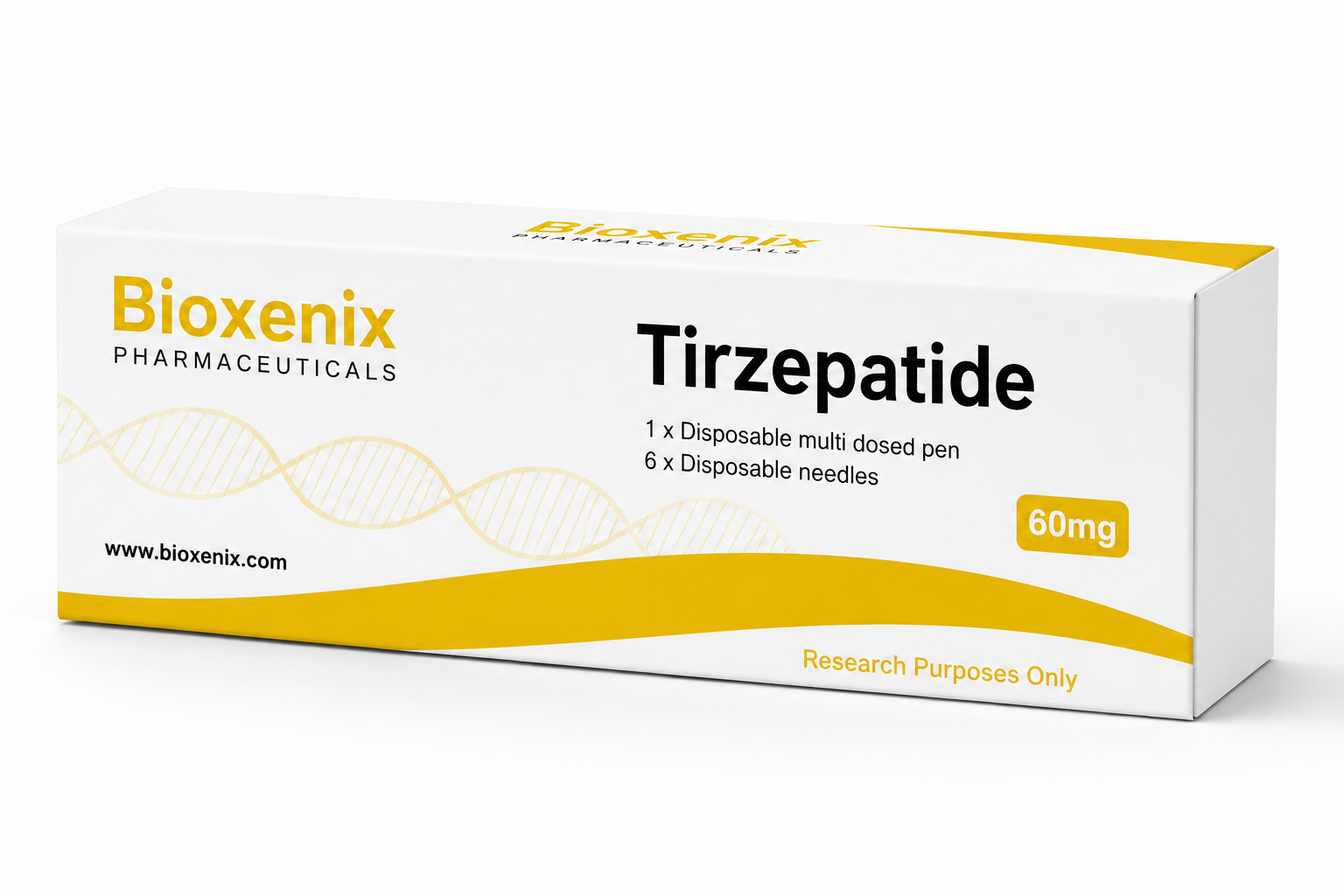
Bioxenix Tirzepatide 60mg Prefilled Pen Kit
Original price was: £160.00.£150.00Current price is: £150.00.
Bioxenix Tirzepatide 60mg Prefilled Pen Kit is a powerful peptide solution for research in metabolic and weight management studies. Trusted for purity and reliability, only at TheWholesale Peptides.
Bioxenix Tirzepatide 60mg Prefilled Pen Kit
Bioxenix Tirzepatide 60mg Prefilled Pen Kit is a multi-dose peptide research preparation containing 60mg of tirzepatide in a 3ml prefilled pen. The current product specification lists a concentration of 20mg/ml and includes six disposable pen needles.
Tirzepatide is a dual GIP and GLP-1 receptor agonist that has been extensively studied in metabolic, endocrine, glucose-regulation, and body-weight research. Its activity across two incretin-related pathways makes it an important subject within contemporary metabolic research.
What Is Tirzepatide?
Tirzepatide is a synthetic peptide-based molecule designed to activate both the glucose-dependent insulinotropic polypeptide (GIP) receptor and the glucagon-like peptide-1 (GLP-1) receptor.
These receptors are involved in complex metabolic signalling pathways associated with glucose regulation, insulin secretion, appetite-related signalling, and energy metabolism.
The dual-receptor activity distinguishes tirzepatide from compounds that primarily target the GLP-1 receptor alone.
For research purposes, this makes the molecule particularly relevant to investigations involving incretin biology and metabolic signalling.
Tirzepatide Research
Research involving tirzepatide has examined several areas of metabolic biology.
Key research topics include:
- GIP receptor signalling
- GLP-1 receptor signalling
- Incretin biology
- Glucose metabolism
- Insulin signalling
- Energy metabolism
- Appetite-related pathways
- Body-composition research
- Metabolic regulation
The biological effects observed in clinical studies should be distinguished from research applications involving laboratory materials.
GIP and GLP-1 Receptor Research
One of the defining characteristics of this molecule is its activity at two incretin-related receptors.
GIP Receptor
GIP is an incretin hormone involved in metabolic regulation. Research into GIP signalling examines its relationship with insulin secretion, nutrient sensing, and energy metabolism.
GLP-1 Receptor
GLP-1 is another important incretin hormone involved in glucose regulation and other physiological signalling pathways.
Studying both receptor systems simultaneously allows researchers to investigate how combined incretin signalling differs from single-pathway approaches.
Metabolic Research Applications
The compound is relevant to several areas of laboratory research.
Glucose Regulation
Researchers can investigate signalling pathways associated with glucose metabolism and insulin-related responses.
Incretin Biology
The molecule provides an experimental model for studying dual GIP and GLP-1 receptor activity.
Energy Metabolism
Laboratory research can examine relationships between incretin signalling, nutrient handling, and energy regulation.
Body Composition Research
Experimental studies may investigate molecular pathways associated with changes in body composition and metabolic activity.
Endocrine Research
The compound is also relevant to broader research into hormone-mediated metabolic signalling.
Bioxenix Tirzepatide 60mg Pen Specifications
| Specification | Details |
|---|---|
| Product | Bioxenix Tirzepatide |
| Strength | 60mg |
| Volume | 3ml |
| Concentration | 20mg/ml |
| Format | Multi-dose prefilled pen |
| Needles included | 6 disposable pen needles |
| Brand | Bioxenix Pharmaceuticals |
| Product category | GLP-1 / Pen Kits / Peptides |
| Intended use | Research use only |
These specifications reflect the current Bioxenix product listing.
Prefilled Pen Research Format
The prefilled format differs from traditional lyophilised peptide vials.
According to the current product listing, the pen contains the prepared formulation and is supplied with six disposable pen needles. The manufacturer describes it as a ready-to-use multi-dose format that does not require reconstitution.
For laboratory research, the prefilled format can simplify sample management and maintain a defined product configuration.
This product page intentionally does not provide administration or dosing instructions.
Quality and Product Documentation
Researchers should consider analytical and batch documentation when evaluating peptide research materials.
Useful documentation may include:
- Batch or lot identification
- Peptide identity
- Purity analysis
- Certificate of Analysis
- Manufacturing information
- Product concentration
- Expiry information
- Storage requirements
Batch-specific documentation should be used as the primary reference for the exact material being studied.
Storage Information
The current Bioxenix listing states that the product should be refrigerated at 2–8°C, should not be frozen, and should be protected from excessive heat and direct sunlight.
Researchers should always follow the storage requirements supplied with the actual product and batch.
Maintaining appropriate storage conditions is particularly important for prepared peptide solutions because environmental conditions can affect product stability.
Tirzepatide and Metabolic Medicine
Tirzepatide is not simply an experimental molecule. It is also the active ingredient in approved prescription medicines.
In the United States, the FDA has approved tirzepatide products for specific medical indications. The current Zepbound prescribing information describes the molecule as a GIP and GLP-1 receptor agonist and includes important safety information.
The existence of approved medical formulations does not mean that a research-labelled product is an approved medicine.
Researchers should distinguish commercial research materials from authorised pharmaceutical products and follow all applicable regulatory requirements.
Research Evidence and Limitations
Tirzepatide has been extensively studied in humans compared with many experimental peptide compounds.
Nevertheless, research material should not be confused with an approved pharmaceutical presentation.
The safety, quality, formulation, concentration, manufacturing controls, and regulatory status of a specific product must be evaluated independently.
Researchers should also avoid transferring pharmaceutical prescribing information directly to an independently supplied research product.
Bioxenix Tirzepatide vs Other Metabolic Peptides
Different metabolic research compounds interact with different biological pathways.
| Compound | Primary research pathway |
|---|---|
| Tirzepatide | GIP + GLP-1 receptor activity |
| Semaglutide | GLP-1 receptor activity |
| Retatrutide | GIP + GLP-1 + glucagon receptor activity |
| GLP-1 research compounds | GLP-1 signalling |
| GIP research compounds | GIP signalling |
This distinction is useful when designing experiments around incretin and metabolic pathways.
Frequently Asked Questions
What is the strength of the Bioxenix pen?
The current product specification lists 60mg of tirzepatide per pen.
What is the concentration?
The listed concentration is 20mg/ml in a 3ml pen.
How many needles are included?
The current Bioxenix listing states that each kit includes 6 disposable pen needles.
What receptors does tirzepatide target?
Tirzepatide acts as an agonist at both the GIP receptor and GLP-1 receptor.
Is this the same as an approved tirzepatide medicine?
No. A research-labelled product should not be represented as an approved pharmaceutical product. Approved tirzepatide medicines have specific regulatory requirements, indications, formulations, and prescribing information.
Does this page provide dosing instructions?
No. This product description is intended for research documentation and does not provide dosing or self-administration instructions.
How should the product be stored?
The current Bioxenix listing specifies refrigerated storage at 2–8°C and advises against freezing or excessive heat exposure.
Research Disclaimer
Bioxenix Tirzepatide 60mg Prefilled Pen Kit is supplied strictly for laboratory and scientific research. It is not intended for human or veterinary consumption or administration. It is not a substitute for an approved pharmaceutical product and should not be represented as a medicine or treatment. Researchers are responsible for complying with applicable laws, regulations, institutional requirements, and laboratory safety procedures.
Related products
GLP-1 / Weight Loss
Performance & Muscle Building
GLP-1 / Weight Loss
Recovery & Wellness
GLP-1 / Weight Loss
Hair & Aesthetics
GLP-1 / Weight Loss
GLP-1 / Weight Loss