
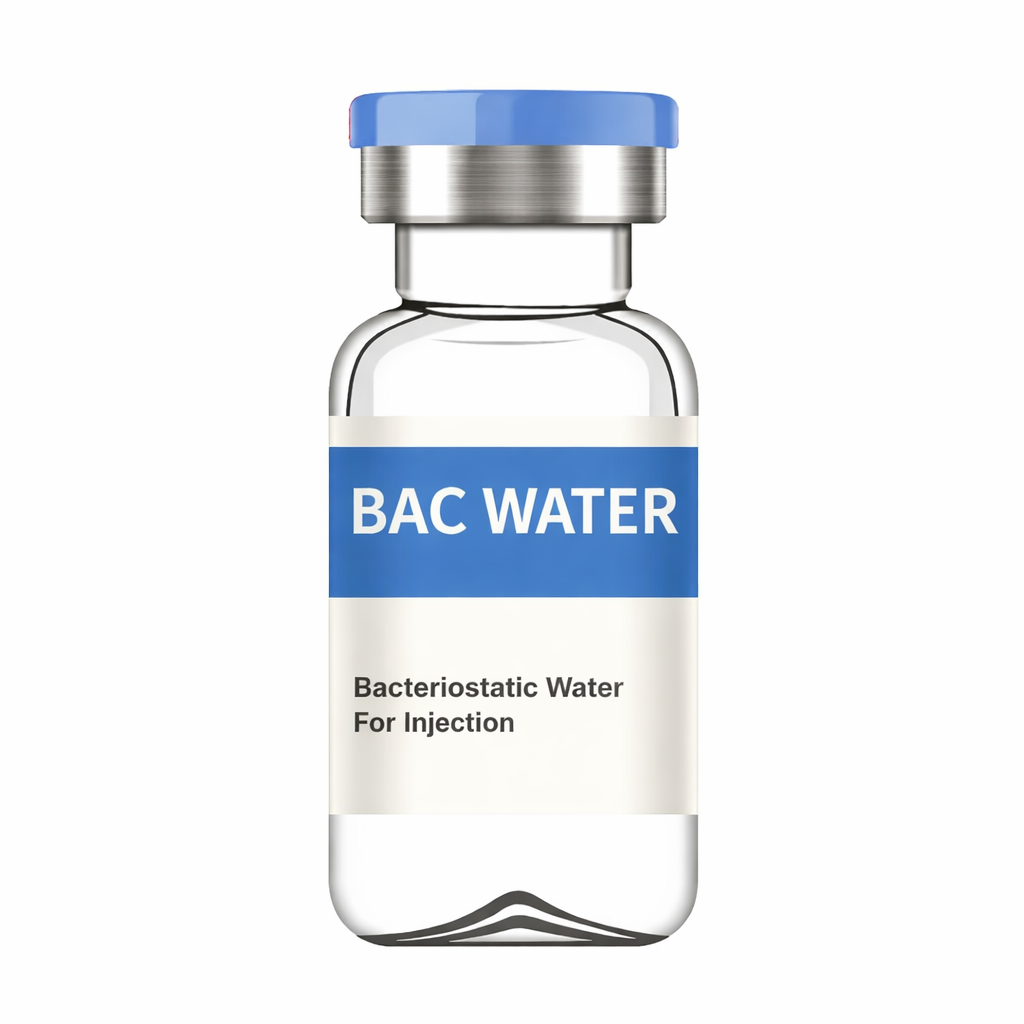
BAC Water x 10 vials
Price range: £25.00 through £35.00
BAC Water X 10 Vials delivers powerful, premium-grade bacteriostatic water for reliable research use. Trusted for purity and quality, only at TheWholesale Peptides.
BAC Water x 10 Vials
BAC Water x 10 vials is a multi-vial laboratory product format containing bacteriostatic water, a sterile aqueous solution formulated with a bacteriostatic preservative. It is commonly discussed in laboratory and research settings where controlled aqueous solutions are required.
The ten-vial format provides individually packaged units that can be useful for laboratory inventory management, research organisation, and controlled storage. The exact composition, volume, preservative concentration, and intended applications should always be confirmed from the product label and manufacturer’s documentation.
Bacteriostatic water should be clearly distinguished from ordinary purified water and from sterile water products without a bacteriostatic preservative.
What Is Bacteriostatic Water?
Bacteriostatic water is sterile water containing an antimicrobial preservative intended to inhibit the growth of microorganisms under appropriate conditions.
The term “bacteriostatic” describes the ability to inhibit bacterial growth. It does not mean that the solution is capable of eliminating every microorganism or that it remains sterile indefinitely after opening.
A typical bacteriostatic-water formulation uses a suitable preservative, such as benzyl alcohol, although the exact formulation depends on the manufacturer and applicable product specifications.
For research purposes, the product should always be identified according to its actual label rather than assuming that every bacteriostatic-water product has the same composition.
BAC Water x 10 Vials Format
The ten-vial format provides multiple individually packaged containers of bacteriostatic water.
This can be useful for laboratories and research environments that require several units for controlled projects or inventory management.
Potential organisational benefits include:
- Individually packaged vials
- Easier inventory tracking
- Batch identification
- Laboratory stock management
- Controlled storage
- Separation between research projects
The total amount of solution supplied depends on the volume of each individual vial.
For example, ten vials containing 10mL each would provide 100mL of total solution. The actual volume should always be confirmed from the product packaging.
Bacteriostatic Water vs Sterile Water
Although the names can sound similar, bacteriostatic water and sterile water are not necessarily the same product.
Bacteriostatic water contains an antimicrobial preservative intended to inhibit microbial growth.
Sterile water may be sterile but does not necessarily contain a bacteriostatic preservative.
This distinction is important because the intended characteristics and permitted applications of different sterile-water products can vary.
Researchers should always check:
- Product label
- Preservative information
- Sterility statement
- Intended use
- Manufacturer instructions
- Regulatory information
The terms should not be treated as interchangeable.
What Makes Bacteriostatic Water Different?
The primary distinction is the presence of a bacteriostatic preservative.
A suitable preservative can help inhibit bacterial multiplication under specified conditions.
However, bacteriostatic water should not be regarded as an unlimited or permanently contamination-resistant solution.
Once a container is opened or handled, appropriate procedures become increasingly important.
Laboratories should follow their own contamination-control practices and the manufacturer’s instructions.
Research Applications
A sterile aqueous solution can have several uses in laboratory science depending on its formulation and intended purpose.
Potential research areas may include:
- Laboratory preparation
- Peptide research
- Biochemical experiments
- Controlled aqueous environments
- Research-compound preparation
- Laboratory solution studies
The specific application must be determined by the product’s intended-use documentation.
Not every bacteriostatic-water product is approved or suitable for every laboratory or clinical application.
BAC Water for Peptide Research
Bacteriostatic water is frequently mentioned alongside research peptides because some peptide formulations require an appropriate aqueous environment for laboratory investigation.
However, different peptides have different physical and chemical characteristics.
Factors such as:
- Peptide structure
- Solubility
- pH
- Concentration
- Formulation
- Preservatives
- Stability
can influence compatibility.
For this reason, researchers should not assume that bacteriostatic water is automatically appropriate for every peptide or research compound.
The relevant product documentation and laboratory protocol should always determine compatibility.
Why the Preservative Matters
The preservative is one of the key characteristics distinguishing bacteriostatic water from preservative-free sterile water.
A bacteriostatic preservative is intended to inhibit the growth of microorganisms under appropriate conditions.
This characteristic can be useful when a product is designed for applications where a preserved sterile solution is specifically required.
However, preservative compatibility is important. Some experimental systems may be sensitive to particular preservatives, so researchers should evaluate the formulation before incorporating it into an experiment.
Laboratory Quality Considerations
When evaluating a bacteriostatic-water product, researchers should look beyond the number of vials.
Important quality information may include:
- Sterility information
- Preservative identity
- Preservative concentration
- Solution volume
- Batch number
- Expiry information
- Manufacturer details
- Packaging integrity
- Storage requirements
Clear labelling helps researchers maintain accurate records and traceability.
For research environments, batch documentation can also be valuable when comparing results between experiments.
BAC Water x 10 Vials and Inventory Management
A ten-vial pack can make laboratory stock easier to organise.
Individually packaged containers can be assigned to different research projects or maintained as separate inventory units.
Good inventory management can include recording:
- Product name
- Batch number
- Number of vials
- Individual volume
- Expiry date
- Storage location
- Date received
These practices can improve traceability and reduce confusion between similar laboratory solutions.
Storage Considerations
The appropriate storage conditions depend on the manufacturer’s formulation and packaging.
Researchers should follow the specific storage information supplied with their product.
General considerations may include protecting unopened containers from:
- Excessive heat
- Direct sunlight
- Freezing where inappropriate
- Physical damage
- Contamination
The vial should remain properly sealed until required for the relevant laboratory procedure.
Once opened, additional contamination-control considerations may apply.
Sterility and Contamination Control
Sterility is particularly important when working with laboratory solutions.
A product being labelled sterile does not mean that contamination is impossible after opening.
Environmental exposure, handling practices, equipment, and storage can all influence contamination risk.
Laboratories should therefore maintain appropriate aseptic and contamination-control procedures relevant to their research environment.
The manufacturer’s instructions should take priority over generic advice.
BAC Water Quality and Product Documentation
Good-quality laboratory water products should have clear documentation describing their composition and intended use.
Researchers evaluating a product may wish to confirm:
- Exact formulation
- Water quality
- Preservative used
- Concentration
- Vial volume
- Sterility status
- Lot or batch identification
- Expiration information
These details help distinguish a properly documented laboratory product from an unidentified aqueous solution.
Common Questions About BAC Water
What is BAC Water?
BAC Water generally refers to bacteriostatic water, a sterile aqueous solution containing a bacteriostatic preservative.
What does bacteriostatic mean?
It means the formulation is designed to inhibit the growth of bacteria under specified conditions. It does not mean that the solution can never become contaminated.
What is the difference between BAC Water and sterile water?
Bacteriostatic water contains a bacteriostatic preservative, while sterile water products may not contain such a preservative.
How many vials are included?
This product format contains 10 individual vials.
What is the volume of each vial?
The individual vial volume should be confirmed from the specific product label. Different products may be supplied in different volumes.
Does BAC Water contain a preservative?
Bacteriostatic-water formulations contain an antimicrobial preservative. The exact preservative and concentration should be verified from the manufacturer’s label.
Can bacteriostatic water be used with every peptide?
No. Compatibility depends on the specific peptide, formulation and research protocol. Researchers should verify compatibility before use.
How should BAC Water be stored?
Storage requirements vary by product. Researchers should follow the manufacturer’s current instructions regarding temperature, light and handling.
Is bacteriostatic water a medicine?
Bacteriostatic water is a sterile solution rather than an active therapeutic drug. The regulatory classification depends on the particular formulation, packaging and intended use.
Is this product intended for human administration?
This page describes the product from a research and laboratory perspective. It should not be interpreted as instructions for human administration.
Important Research Information
Bacteriostatic water should be selected according to the requirements of the specific research application.
Researchers should confirm the product’s formulation, sterility, preservative content, compatibility and intended use before incorporating it into an experiment.
It is also important not to confuse research-grade products with products manufactured and approved specifically for clinical use.
Where a product is labelled Research Use Only, it should remain within the scope specified by the manufacturer and applicable regulations.
Summary
BAC Water x 10 vials provides a convenient multi-vial format of bacteriostatic water for appropriate laboratory and research applications.
The key characteristic of this type of solution is its sterile aqueous formulation combined with a bacteriostatic preservative. This distinguishes it from preservative-free sterile water and other laboratory-grade water products.
For research environments, the ten-vial format can simplify inventory management, batch tracking and laboratory organisation. Researchers should verify the exact vial volume, formulation, preservative concentration, sterility information and storage requirements from the specific product documentation.
Research Use Only. Not for human consumption or self-administration.
bac water,
bacteriostatic water,
sterile water,
bacteriostatic,
hospira bac water,
hospira bacteriostatic water,
bac water hospira,
bacteriostat,
bac water uk.
| ML | 3ML, 10ML |
|---|
Related products
Longevity & Cellular Health
Performance & Muscle Building
Performance & Muscle Building
Performance & Muscle Building
GLP-1 / Weight Loss
Recovery & Wellness
GLP-1 / Weight Loss
Longevity & Cellular Health