
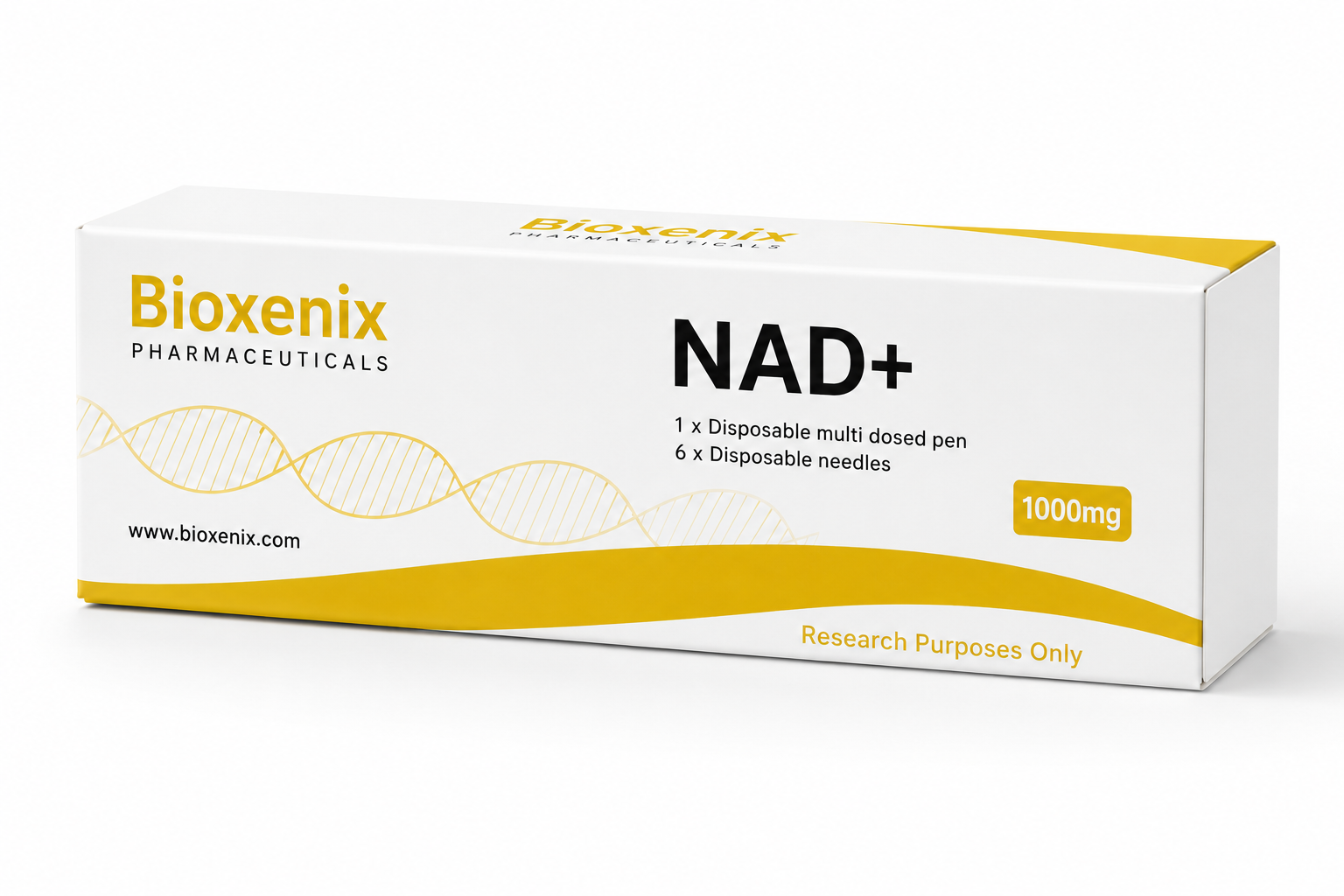
Bioxenix NAD+ 1000mg
Bioxenix NAD+ 1000mg is a high-strength NAD+ research formulation designed for laboratory research involving cellular metabolism, energy production, redox signalling, and age-related biological processes. NAD+, or nicotinamide adenine dinucleotide, is a naturally occurring coenzyme found throughout living cells and plays a central role in numerous metabolic reactions.
NAD+ research has expanded considerably because of the molecule’s involvement in mitochondrial function, cellular energy metabolism, DNA repair pathways, oxidative balance, and other fundamental biological processes.
What Is Bioxenix NAD+ 1000mg?
Bioxenix NAD+ 1000mg is a research product containing a stated 1000mg amount of NAD+. NAD+ is an essential coenzyme involved in transferring electrons during cellular metabolic reactions.
Unlike peptides such as BPC-157 or GHK-Cu, NAD+ is a small molecule coenzyme rather than a peptide. It is naturally present in cells and is involved in processes required for normal cellular function.
The 1000mg specification describes the stated quantity of NAD+ associated with the product presentation. Researchers should distinguish between total product content, concentration, formulation, and experimental requirements.
What Is NAD+?
NAD+ stands for nicotinamide adenine dinucleotide in its oxidized form.
It is one of the most important coenzymes involved in cellular metabolism. NAD+ participates in oxidation-reduction reactions, allowing cells to transfer electrons during processes associated with energy production.
NAD+ exists in two major forms:
- NAD+ – oxidized form
- NADH – reduced form
The NAD+/NADH pair helps regulate cellular redox reactions and is particularly important for metabolic pathways associated with mitochondria.
How Does NAD+ Work in Cells?
NAD+ acts as an electron carrier in numerous biochemical reactions.
During metabolic processes, NAD+ can accept electrons and hydrogen to form NADH. NADH can subsequently participate in electron-transfer processes associated with mitochondrial energy production.
This makes NAD+ relevant to several fundamental areas of cellular biology, including:
- Cellular energy metabolism
- Mitochondrial function
- Redox signalling
- Oxidative metabolism
- DNA repair
- Cellular stress responses
- Enzyme activity
- Metabolic regulation
Because NAD+ participates in so many cellular processes, changes in NAD+ availability and metabolism have become an important area of scientific investigation.
NAD+ and Mitochondrial Research
Mitochondria are often described as the energy-producing structures of cells. They generate much of the cellular energy required for biological activity through oxidative phosphorylation.
NAD+ and NADH are central components of this process.
NADH transfers electrons through mitochondrial pathways, ultimately contributing to the generation of ATP, the primary energy currency used by cells.
Consequently, NAD+ research can help scientists investigate relationships between coenzyme availability, mitochondrial metabolism, cellular energy production, and metabolic stress.
Bioxenix NAD+ 1000mg and Cellular Energy Research
Cellular energy production is one of the most important research areas associated with NAD+.
Cells constantly require energy for processes such as:
- Protein synthesis
- Cellular signalling
- Membrane transport
- DNA maintenance
- Cell division
- Tissue maintenance
- Metabolic reactions
NAD+ participates in several pathways that support these processes.
Research into NAD+ therefore extends beyond a simple focus on “energy” and includes the broader study of cellular metabolism and biochemical regulation.
NAD+ and Redox Biology
Redox reactions involve the transfer of electrons between molecules.
The NAD+/NADH system is an important component of cellular redox biology. Maintaining appropriate redox balance is essential for normal cellular metabolism.
Researchers study NAD+-dependent redox reactions to better understand how cells respond to metabolic changes, oxidative stress, nutrient availability, and other environmental conditions.
This makes NAD+ particularly relevant to research involving cellular stress and metabolic adaptation.
NAD+ and DNA Repair Research
NAD+ is also involved in cellular processes related to DNA maintenance.
Several enzymes involved in DNA repair and cellular signalling depend on NAD+ as a substrate or cofactor. One widely studied group is the sirtuin family, while another important enzyme family includes PARPs, or poly(ADP-ribose) polymerases.
NAD+ availability can therefore influence biological pathways involved in cellular responses to DNA damage.
This connection between NAD+ metabolism and DNA maintenance is an important area of longevity and cellular-ageing research.
NAD+ and Sirtuin Research
Sirtuins are NAD+-dependent enzymes involved in several cellular processes.
Research into sirtuins has examined their potential roles in:
- Metabolic regulation
- Gene expression
- Cellular stress responses
- Mitochondrial biology
- DNA maintenance
- Cellular ageing
Because sirtuin activity depends on NAD+, researchers have become interested in the relationship between NAD+ metabolism and sirtuin signalling.
NAD+ and Longevity Research
NAD+ has become particularly popular within longevity research.
Studies have investigated how NAD+ metabolism changes with age and how these changes may interact with mitochondrial function, cellular stress, DNA repair, and metabolic regulation.
However, longevity research is complex. Findings from cellular and animal studies cannot automatically be translated into proven anti-ageing effects in humans.
For this reason, NAD+ should be discussed in the context of scientific research rather than unsupported claims about reversing ageing.
NAD+ Research and Cellular Ageing
Cellular ageing involves numerous biological processes rather than a single mechanism.
Researchers investigating NAD+ have examined relationships involving:
- Mitochondrial function
- Cellular metabolism
- DNA repair
- Oxidative stress
- Sirtuin activity
- Cellular signalling
- Metabolic adaptation
Understanding these pathways may help scientists investigate how cells respond to age-related changes.
NAD+ vs NADH
NAD+ and NADH are closely related but chemically different forms of the same coenzyme system.
NAD+ is the oxidized form and can accept electrons.
NADH is the reduced form and carries electrons generated during metabolic reactions.
The balance between NAD+ and NADH is often referred to as the cellular NAD redox state. This balance is an important subject in metabolic and mitochondrial research.
NAD+ vs NAD Precursors
NAD+ can also be studied alongside compounds that act as NAD precursors.
Commonly researched NAD-related molecules include:
- Nicotinamide
- Nicotinamide riboside (NR)
- Nicotinamide mononucleotide (NMN)
- NAD+
- NADH
These compounds should not be considered identical. They participate in NAD metabolism in different ways, and researchers should distinguish between the parent coenzyme and its precursor molecules.
Bioxenix NAD+ 1000mg Research Areas
For researchers, NAD+ may be relevant to several scientific fields, including:
- Cellular metabolism
- Mitochondrial biology
- Redox biology
- Energy metabolism
- DNA repair research
- Sirtuin research
- Cellular ageing
- Longevity research
- Oxidative stress research
- Metabolic signalling
- Enzyme biology
- Cellular stress responses
The relevance of NAD+ depends on the specific experimental model and research question.
Quality Considerations for NAD+ Research
When evaluating NAD+ research materials, researchers should consider available information relating to:
- Compound identity
- Stated quantity
- Purity
- Batch information
- Analytical testing
- Manufacturing information
- Packaging integrity
- Storage conditions
- Product documentation
A product description alone cannot establish the purity or suitability of a research compound. Analytical documentation and appropriate laboratory testing provide more meaningful information when evaluating research materials.
Storage and Handling
Storage requirements can depend on the specific formulation, packaging, and manufacturer’s instructions.
Researchers should always follow the storage and handling information supplied with the specific product.
Important considerations may include:
- Temperature
- Moisture exposure
- Light exposure
- Packaging integrity
- Stability information
- Batch documentation
Research materials should be handled according to appropriate laboratory procedures.
Frequently Asked Questions
What is Bioxenix NAD+ 1000mg?
Bioxenix NAD+ 1000mg is a research formulation containing a stated 1000mg amount of NAD+, a naturally occurring coenzyme involved in cellular metabolism and redox reactions.
What does NAD+ stand for?
NAD+ stands for nicotinamide adenine dinucleotide in its oxidized form.
What does NAD+ do?
NAD+ participates in numerous biochemical reactions, particularly oxidation-reduction processes involved in cellular metabolism and energy production.
Is NAD+ a peptide?
No. NAD+ is a coenzyme and small molecule rather than a peptide.
What is NADH?
NADH is the reduced form of NAD+. Together, NAD+ and NADH form an important redox pair involved in cellular metabolism.
Why is NAD+ studied in longevity research?
NAD+ is involved in mitochondrial metabolism, redox balance, DNA-related processes, and NAD+-dependent enzymes such as sirtuins. These connections have made NAD+ an important subject within cellular ageing research.
Is NAD+ the same as NMN?
No. NAD+ and NMN are different molecules. NMN is a precursor involved in NAD+ biosynthesis, whereas NAD+ is the active coenzyme itself.
Is NAD+ the same as nicotinamide riboside?
No. Nicotinamide riboside, or NR, is an NAD precursor. NAD+ is the resulting coenzyme involved in numerous cellular reactions.
What does 1000mg mean?
The 1000mg specification refers to the stated total quantity of NAD+ associated with the product presentation. It should not be interpreted as a recommended amount for human use.
What research areas involve NAD+?
NAD+ is studied in cellular metabolism, mitochondrial biology, redox biology, DNA maintenance, sirtuin signalling, ageing research, and metabolic physiology.
Related NAD+ Research Topics
For broader organic-search coverage, useful related topics include:
- NAD+ 1000mg
- Bioxenix NAD+
- NAD+ research
- What is NAD+
- NAD+ benefits research
- NAD+ and mitochondria
- NAD+ cellular energy
- NAD+ and ageing
- NAD+ longevity research
- NAD+ vs NADH
- NAD+ vs NMN
- NAD+ vs NR
- Nicotinamide adenine dinucleotide
- Sirtuin research
- Cellular metabolism
- Mitochondrial research
- Redox biology
- NAD metabolism
Important Information
Bioxenix NAD+ 1000mg should be presented according to its intended research designation and applicable regulations. This content is provided for educational and research-information purposes only and does not constitute medical advice.
Research findings involving NAD+ should not automatically be interpreted as evidence that a particular NAD+ product treats disease, reverses ageing, increases lifespan, or produces a specific health outcome in humans.
Researchers should consult appropriate scientific documentation and qualified professionals when evaluating research compounds and laboratory materials.
Bioxenix NAD+ 1000mg, Bioxenix NAD+ 1000mg, Bioxenix NAD+ 1000mg, Bioxenix NAD+ 1000mg, Bioxenix NAD+ 1000mg, Bioxenix NAD+ 1000mg,
what is nad,
what are nad,
what is nad supplement,
what is nad+,
what does nad mean in medical terms.
Related products
GLP-1 / Weight Loss
Hair & Aesthetics
GLP-1 / Weight Loss
Recovery & Wellness
GLP-1 / Weight Loss
GLP-1 / Weight Loss
Hair & Aesthetics
Hair & Aesthetics