
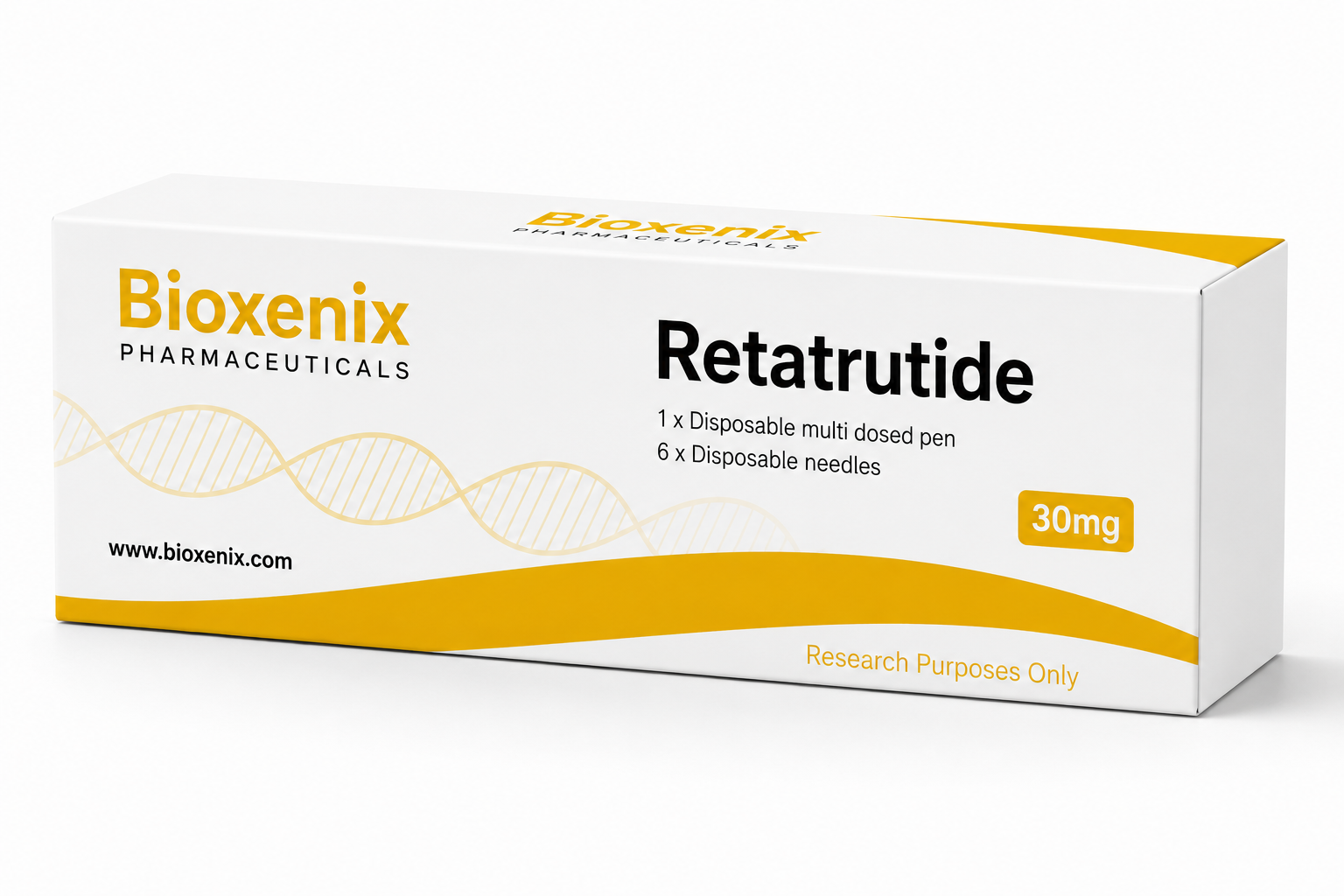
Bioxenix Retatrutide 30mg
Bioxenix Retatrutide 30mg is a research-use formulation containing retatrutide, an investigational triple hormone receptor agonist being studied for its activity across the GIP, GLP-1, and glucagon receptor pathways. Bioxenix currently lists the 30mg product as a prefilled pen with a stated concentration of 10mg/ml.
Retatrutide, also known as LY3437943, has attracted substantial scientific interest because it activates three metabolic hormone receptor pathways within a single molecule. Current clinical research is investigating retatrutide in obesity, type 2 diabetes, cardiovascular and renal outcomes, obstructive sleep apnea, knee osteoarthritis, and other metabolic conditions.
What Is Bioxenix Retatrutide 30mg?
Bioxenix Retatrutide 30mg is a retatrutide research product presented in a prefilled pen format. The manufacturer’s current listing identifies the product as a 30mg prefilled pen with a stated concentration of 10mg/ml and places it within its GLP-1, peptide, pen-kit, and weight-loss research categories.
Retatrutide is different from conventional GLP-1-only compounds because it interacts with three receptor pathways:
- GIP receptor
- GLP-1 receptor
- Glucagon receptor
This triple mechanism is a central reason why retatrutide has become an important subject in modern metabolic research.
What Is Retatrutide?
Retatrutide is an investigational molecule developed by Eli Lilly and identified by the development code LY3437943.
It is commonly described as a triple agonist because it activates the receptors for glucose-dependent insulinotropic polypeptide (GIP), glucagon-like peptide-1 (GLP-1), and glucagon.
Unlike a conventional GLP-1 receptor agonist, retatrutide combines three distinct metabolic signalling pathways. This makes it particularly relevant to researchers studying the interaction between incretin biology, appetite regulation, glucose metabolism, and energy balance.
How Does Retatrutide Work?
Retatrutide interacts with three hormone receptor systems.
GIP Receptor Activity
GIP, or glucose-dependent insulinotropic polypeptide, is an incretin hormone involved in nutrient-related metabolic signalling.
Research into GIP pathways has examined their relationship with insulin secretion, nutrient metabolism, and energy regulation.
GLP-1 Receptor Activity
GLP-1 is another important incretin hormone. GLP-1 receptor signalling has been widely studied in relation to glucose regulation, appetite, gastrointestinal processes, and energy balance.
Glucagon Receptor Activity
Glucagon plays an important role in maintaining metabolic balance. Glucagon receptor signalling is associated with processes involving glucose regulation and energy metabolism.
Retatrutide’s simultaneous activity at all three receptors gives researchers a unique model for studying combined metabolic signalling.
Why Is Retatrutide Important in Peptide Research?
Retatrutide has become a major research topic because it represents a different approach to metabolic receptor activation.
Instead of targeting only GLP-1, or GIP and GLP-1 together, retatrutide targets:
GIP + GLP-1 + Glucagon
This triple-receptor mechanism has generated considerable interest in pharmaceutical and metabolic research. Lilly’s current development pipeline identifies retatrutide as an investigational GIP/GLP-1/glucagon receptor agonist.
Retatrutide 30mg and Metabolic Research
Research involving retatrutide covers several areas of metabolic science.
Potential research areas include:
- Incretin receptor signalling
- GIP receptor activity
- GLP-1 receptor activity
- Glucagon receptor activity
- Glucose homeostasis
- Appetite signalling
- Energy balance
- Metabolic physiology
- Body-weight regulation
- Cardiometabolic research
These areas help researchers investigate how multiple hormonal pathways can interact to influence metabolic processes.
Retatrutide and Weight-Management Research
Retatrutide has attracted particular attention because of its clinical development in obesity research.
In the Phase 3 TRIUMPH-1 trial, Lilly reported substantial weight reduction among participants receiving retatrutide, with results announced in May 2026. The study evaluated adults with obesity or overweight and at least one weight-related condition who did not have diabetes.
Further Phase 3 results were subsequently announced in studies involving people with type 2 diabetes and people with established cardiovascular disease.
These findings are part of an ongoing clinical-development program and should not be interpreted as evidence that an independently marketed research product is an approved treatment.
Bioxenix Retatrutide 30mg Product Characteristics
According to the current Bioxenix listing, the product is presented as:
- Product: Retatrutide 30mg Prefilled Pen
- Stated total amount: 30mg
- Stated concentration: 10mg/ml
- Format: Prefilled pen
- Product category: GLP-1 / Pen Kits / Peptides / Weight Loss
- Intended designation: Research Use Only
These specifications describe the manufacturer’s product presentation and should not be interpreted as a recommended amount for human use.
Retatrutide 30mg vs Retatrutide 60mg
Retatrutide research products can be presented in different total amounts.
Bioxenix currently lists both 30mg and 60mg prefilled pen products.
The 30mg and 60mg labels refer to the stated total quantity contained in each product presentation. Researchers should distinguish between:
- Total product content
- Concentration
- Product volume
- Experimental amount
These terms describe different characteristics and should not be treated as interchangeable.
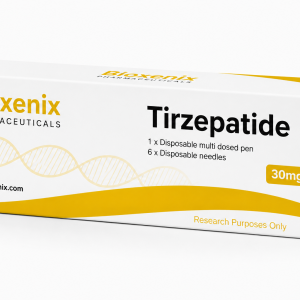
Retatrutide vs Tirzepatide
Retatrutide and tirzepatide are both important compounds in metabolic research, but their receptor profiles differ.
| Compound | Main receptor activity |
|---|---|
| Tirzepatide | GIP + GLP-1 |
| Retatrutide | GIP + GLP-1 + glucagon |
The additional glucagon receptor activity is a defining feature of retatrutide and is one reason the compound is classified as a triple agonist.
This distinction makes retatrutide vs tirzepatide a useful research topic for readers interested in incretin and metabolic pharmacology.
Retatrutide vs Semaglutide
Semaglutide primarily targets the GLP-1 receptor, whereas retatrutide has activity across GIP, GLP-1, and glucagon receptors.
This difference in receptor activity is important when comparing the pharmacological concepts behind these compounds.
However, comparisons should distinguish between approved medicines and investigational compounds. Retatrutide remains under clinical development rather than being an approved medicine for public use.
Research Quality Considerations
Quality and characterization are important when evaluating peptide-based research materials.
Researchers may consider:
- Compound identity
- Purity
- Stated concentration
- Batch information
- Analytical testing
- Packaging integrity
- Storage conditions
- Manufacturer documentation
- Product labeling
A product listing alone cannot establish the identity, purity, sterility, or suitability of a research compound. Independent analytical information and appropriate laboratory procedures are therefore important considerations.
Storage and Handling
Storage requirements depend on the specific formulation and manufacturer’s instructions.
Researchers should follow the documentation supplied with the particular product and batch. Proper storage and handling are important considerations when working with peptide-based materials.
Check the manufacturer’s information regarding:
- Storage temperature
- Light exposure
- Packaging
- Product stability
- Handling requirements
- Batch documentation
Research materials with damaged packaging, unclear labels, or uncertain storage history should be treated cautiously.
Is Retatrutide Approved?
Retatrutide remains an investigational compound and is not currently available for public use. Lilly states that retatrutide is being studied in Phase 3 clinical trials and is available only to participants in its clinical trials.
Lilly announced in July 2026 that it plans to submit a Biologics License Application for retatrutide to the FDA in Q1 2027.
Therefore, research products marketed as retatrutide should not be represented as equivalent to an approved pharmaceutical medicine.
Important Safety Information
Because retatrutide remains investigational, its safety and efficacy continue to be evaluated through controlled clinical research.
Lilly has also warned about products claiming to contain retatrutide outside its sponsored clinical trials, noting that such products may contain unknown ingredients, contaminants, incorrect amounts of active ingredient, or different substances.
For that reason, Bioxenix Retatrutide 30mg should be described accurately as a research product rather than a treatment for obesity, diabetes, or another medical condition.
Frequently Asked Questions
What is Bioxenix Retatrutide 30mg?
Bioxenix Retatrutide 30mg is a retatrutide research product presented as a prefilled pen. Bioxenix currently lists the product with a stated 30mg amount and 10mg/ml concentration.
What is retatrutide?
Retatrutide, also known as LY3437943, is an investigational triple hormone receptor agonist targeting GIP, GLP-1, and glucagon receptors.
What does 30mg mean?
The 30mg specification refers to the stated total amount of retatrutide in the particular product presentation. It should not be interpreted as an individual recommended amount.
What is the concentration of Bioxenix Retatrutide 30mg?
Bioxenix currently lists the 30mg prefilled pen at a stated concentration of 10mg/ml.
Is retatrutide a GLP-1 peptide?
Retatrutide activates the GLP-1 receptor but is more accurately described as a GIP, GLP-1, and glucagon triple receptor agonist.
Is retatrutide the same as tirzepatide?
No. Tirzepatide activates GIP and GLP-1 receptors, whereas retatrutide additionally activates the glucagon receptor.
Is Bioxenix Retatrutide 30mg an approved medicine?
The Bioxenix product is presented as a research-use product, while retatrutide itself remains investigational and is not currently approved for public use.
Why is retatrutide being studied?
Retatrutide is being studied across several metabolic areas, including obesity, type 2 diabetes, knee osteoarthritis, obstructive sleep apnea, cardiovascular and renal outcomes, and metabolic dysfunction-associated steatotic liver disease.
Related Retatrutide Search Topics
For broader organic-search coverage, useful related topics include:
- Retatrutide 30mg
- Bioxenix Retatrutide
- Retatrutide peptide
- LY3437943
- Retatrutide research
- GIP GLP-1 glucagon agonist
- Triple agonist peptide
- Retatrutide mechanism of action
- Retatrutide vs tirzepatide
- Retatrutide vs semaglutide
- Retatrutide clinical trials
- Retatrutide Phase 3
- GIP receptor research
- GLP-1 receptor research
- Glucagon receptor research
- Metabolic peptide research
Important Information
Bioxenix Retatrutide 30mg is presented as a research-use product. Retatrutide itself remains an investigational compound and is not currently approved for public use.
This content is provided for educational and research-information purposes only. It does not provide dosing or administration instructions and should not be interpreted as a recommendation for human use or treatment of obesity, diabetes, or another medical condition.
Bioxenix Retatrutide 30mg, Bioxenix Retatrutide 30mg, Bioxenix Retatrutide 30mg, Bioxenix Retatrutide 30mg, Bioxenix Retatrutide 30mg,
what is reta,
what is retatrutide,
is retatrutide safe,
where can i buy retatrutide online,
what does retatrutide do,
does retatrutide burn fat,
how does retatrutide work.
how long does retatrutide take to work,
how to take retatrutide,
where to buy retatrutide,
when will retatrutide be available,
how much retatrutide should i take,
how to use retatrutide pen.

Related products

GLP-1 / Weight Loss
Pen Kits (prefilled)
Performance & Muscle Building
Recovery & Wellness
GLP-1 / Weight Loss

Pen Kits (prefilled)
GLP-1 / Weight Loss